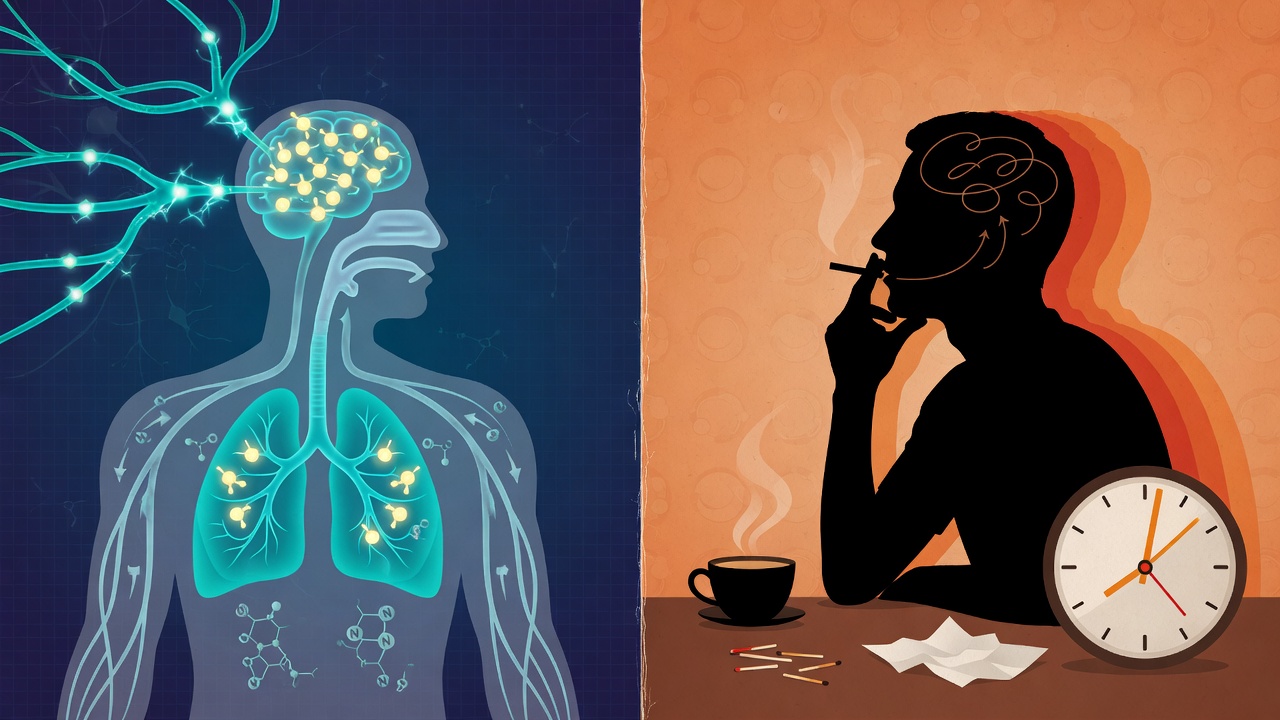
Many people fail to quit smoking — not because they don't want to, but because they're fighting the wrong battle. Distinguishing psychological from physiological dependence allows you to put your limited willpower where it matters most.
Psychological Dependence vs. Physiological Dependence: How to Identify and Break Through Specifically
Many people fail to quit smoking — not because they "don't want to quit enough," but because they are **fighting the wrong battle**.
Some people experience hand tremors, insomnia, and restlessness on the third day, yet they only grit their teeth and endure; others use nicotine patches, and once the physical flush passes, they still automatically reach for their pocket after meals, before meetings, or the moment they open WeChat. Both kinds of discomfort can be called "craving a cigarette," but the **blocking points** are completely different: one leans more toward **physiological dependence**, the other more toward **psychological dependence**. More often, the two are intertwined — just at different stages, one dominates over the other.
This article aims to help you do three things in the clearest way possible:
**Disclaimer:** This article is for health popularization purposes only and does not constitute individual diagnosis, prescription, or psychotherapy advice. If you experience severe depression, suicidal thoughts, chest pain, significant heart rhythm abnormalities, or are pregnant/preparing for pregnancy or have important chronic diseases, please promptly seek help from a licensed physician or professional smoking cessation clinic.
1. First Recognize: What Two "Forces" Are You Fighting Against?
1. Physiological Dependence: The Body Has Already Written Nicotine into "Daily Operations"
After nicotine enters the bloodstream, it acts on nicotinic acetylcholine receptors in the central nervous system and involves dopamine and other pathways related to reward, attention, and emotional regulation. After long-term regular exposure, the nervous system undergoes **adaptation**:
**Common physiological manifestations (vary by individual):**
| Category | Possible Feelings |
|---|---|
| Nervous & Emotional | Irritability, increased anxiety, easy anger, mood swings |
| Cognitive | Difficulty concentrating, brain "not working," reduced foresight |
| Physical | Sensation of heart rate/blood pressure changes, headache, sweet or bland taste in mouth, constipation or gastrointestinal discomfort |
| Sleep & Appetite | Difficulty falling asleep or drowsiness, nighttime awakening, increased appetite |
| Craving Rhythm | Especially in the first few days after quitting, cravings come in paroxysmal "waves," possibly related to previous smoking intervals |
**Time perspective (empirical, for expectation management, not precise medical promises):**
Remember: **Your timeline may be longer or shorter than others'.** Daily smoking volume, inhalation depth, simultaneous heavy coffee consumption/staying up late, and whether you have an underlying anxiety or depression — all can rewrite the experience.
2. Psychological Dependence: Smoking Has Already Been Embedded into Emotions, Identity, and Life Scripts
Psychological dependence is not "drama" — it is the result of learning and memory. After smoking is repeatedly bound to specific situations, the brain builds shortcuts:
This signal appears → smoke → brief relaxation/focus/social ease → reinforcement of "do it again next time."
**Common psychological drivers:**
| Type | Example |
|---|---|
| Situational cues | After meals, driving, on the way to work, bathroom, balcony, drinking sessions, waiting for someone |
| Emotional cues | Stress, anger, boredom, loneliness, excitement, rewarding oneself |
| Ritual & handling | Opening a pack, lighting up, holding posture, deep inhale, watching the cigarette tip |
| Social & identity | "Not smoking seems unsociable," cigarette-offering culture, "I'm just a seasoned smoker" |
| Cognitive excuses | "Just one," "Today is too hard," "I'll quit for real tomorrow" |
Thus a typical phenomenon appears:
**The body no longer feels uncomfortable, yet "days without smoking" still feel wrong.**
What's wrong is not that the lungs suddenly command you to smoke, but that **a whole set of automatic scripts is still playing out.**
3. How Do the Two Entangle Together?
Most long-term smokers are **mixed type**:
**Strategy mismatch** is a hidden driver of relapse:
Identifying the type is not for labeling or shaming yourself, but for **putting your limited willpower where it matters most.**
2. Simple Self-Assessment: Are You More Stuck on Physiological, Psychological, or Both?
The following tools are for **self-awareness and action prioritization**, cannot replace clinical diagnosis, and cannot provide a single truth like a lab report. It is recommended to take the assessment while relatively sober and not hungover; results can change when repeated in different weeks of quitting.
Self-Assessment A: 24–72 Hour "Physical Ledger" (Physiological Bias)
Recall the **first three days** of your most recent serious attempt to reduce/quit smoking (if you've never tried, observe physical reactions during a "long gap" or when you "can't smoke during a flight/meeting"), and check "Significant / Slight / Almost none" for the following items:
**Rough interpretation:**
Self-Assessment B: Cue Map (Psychological Bias)
In the past week, which moments did you "most want to smoke"? Check in the table and label the driver type.
| Trigger Scenario | Often Hit | More Like Physical Discomfort | More Like Habit/Emotion/Social | Notes (Automatic Thoughts) |
|---|---|---|---|---|
| First cigarette after waking | ☐ | ☐ | ☐ | |
| After meals / coffee | ☐ | ☐ | ☐ | |
| Driving / waiting at red light | ☐ | ☐ | ☐ | |
| Work stress / deadline | ☐ | ☐ | ☐ | |
| Drinking session / friend lighting up | ☐ | ☐ | ☐ | |
| Bored scrolling on phone | ☐ | ☐ | ☐ | |
| Bathroom / balcony "fixed theater" | ☐ | ☐ | ☐ | |
| Reward: "Do this then I can smoke" | ☐ | ☐ | ☐ | |
| After an argument / anxiety attack | ☐ | ☐ | ☐ | |
| Seeing others smoke or smelling smoke | ☐ | ☐ | ☐ |
**Rough interpretation:**
Self-Assessment C: Three Watershed Questions (Quick Orientation)
Answer with "Yes / No":
**Reference orientation:**
| Pattern | Possible Direction | Strategy Priority |
|---|---|---|
| Crave nicotine itself more, strong physical waves | Physiological bias | NRT/medication assessment + withdrawal period routine |
| Crave the action and scenario closure more | Psychological bias | Cue disruption + behavior replacement + social scripts |
| Both strong | Mixed type | Stabilize physiology 1–2 weeks first, simultaneously map triggers |
| Body is fine but "quitting doesn't feel like me" | Identity-type psychological dependence | Identity reconstruction + long-term meaning design |
Self-Assessment D: Two "Hard Indicators" from FTND Thinking (Popular Science Level)
Among clinical nicotine dependence assessments (such as FTND), two items carry significant information. Use as reference, not self-diagnosis:
Treat them as **indicator lights for whether you need professional cessation support** — not as shame scores.
3. For Physiological Dependence: Let the Body "Land Softly"
The goal is not to "prove you can quit cold turkey," but to **reduce withdrawal intensity so you have cognitive bandwidth to handle psychological cues.**
1. Medical Support: Understand the Logic First, Then Decide Whether to See a Doctor
**Nicotine Replacement Therapy (NRT):** The core idea is to use more controlled nicotine doses and delivery methods to ease the receptor "sudden vacancy" while cutting off exposure to thousands of combustion products in smoke.
| Formulation Idea | Characteristics (Popular Science) | Suitable Discussion Direction |
|---|---|---|
| Patch | Relatively steady transdermal release, baseline coverage | Those with high baseline daytime craving, prone to forgetting "on-demand medication" |
| Gum / Lozenge | Relatively fast onset, can be used on craving | Those with paroxysmal waves, needing oral movement replacement |
| Combination strategy | "Steady baseline + on-demand peak dose" | Common approach in many guideline contexts, needs individualization |
| Nasal spray etc. | Can work quickly but involves nasal mucosa | Those with rhinitis/nasal sensitivity need special caution, follow doctor's advice |
**Prescription medication directions (knowledge only):** Such as bupropion hydrochloride, varenicline, etc., reduce craving or weaken smoking reward through different neural mechanisms. **Contraindications, interactions, and dosage must be evaluated by a physician** — this article does not provide self-applicable prescription plans.
**Important boundaries:**
2. Non-Medication: Reduce the Nervous System's Load
During the physiological withdrawal period, the body is more sensitive to stress. An executable checklist:
3. Expectation Management: Turn Off "Catastrophizing"
What drains you most in physiological dependence is often not the symptoms themselves, but the thoughts:
"I will always feel this terrible."
"I can't keep going."
"This proves I can't quit."
A more realistic reframe:
"I am riding a wave. The wave will move. My job is to ride it safely, not to evaluate my entire life at the peak."
If low mood rapidly worsens or you have thoughts of self-harm, **immediately stop "self-help through articles"** and contact a professional or local emergency support channel.
4. For Psychological Dependence: Dismantle the Script, Not Just Argue With Yourself
The essence of breaking psychological dependence is: **Make old cues lose their "automatic cigarette-dispensing" power, and give emotions and hands new tasks.**
1. First Draw a "Trigger Map" (Three Days Is Enough to Start)
Prepare a phone memo, every time you crave a cigarette (whether you smoke or not), note one line:
`Time | Place | With Whom | Emotion (0-10) | Automatic Thought | What You Did | Post-Evaluation`
After three days, you'll usually see: it's not "wanting to smoke anytime anywhere," but **2–5 high-risk scripts** playing on repeat. Prioritize eliminating the 1–2 most frequent ones — far more efficient than "banning all life pleasures."
2. Stimulus Control: Changing the Environment Is Cheaper Than Changing Your Personality
| High-Risk Script | Environment Modification | Replacement Action (30–120 sec) |
|---|---|---|
| One after meals | Brush teeth immediately/clear the table/leave the table | Sugar-free gum, short walk |
| Smoking in car | Remove ashtray and car smell; be cautious with scents due to allergies | Water, mint lozenge, handle emotions when you arrive |
| Work stress | Move cigarettes and lighter out of "arm's reach" | 2-min standing + stretch, break tasks into Pomodoros |
| Drinking session | Prepare a refusal line in advance; seat away from smoking area | Hold a drink, be the photographer/order food to shift role |
| Bathroom/balcony theater | Change routes: don't bring cigarettes to bathroom; balcony use for storage | Lengthen hand-washing ritual, listen to one minute of audio |
| Boredom | Give hands "legal toys" | Grip trainer, knitting, clear five items off desk |
Principle: **Increase the friction for smoking; decrease the friction for replacement behaviors.**
3. Cognitive Unbinding: Downgrade "I Want to Smoke" to "Notification"
Psychological dependence often hijacks you with one sentence: "I want to smoke = I must smoke = it's over if I don't."
Practice three steps:
4. Social Scripts: Pre-Write, No Improv On-Site
The cigarette-offering culture precisely targets psychological dependence. Prepare 2 lines:
No lengthy moral speeches needed. Your goal is to **shorten the negotiation window** and prevent "hospitality hard to refuse" from becoming automatic relapse.
5. Identity Reconstruction: From "Someone Who Smokes Moderately" to "Someone Who Can Ride the Wave"
Long-term smokers often weave smoking into their self-narrative. Gently rewrite instead of self-deprecating:
Identity change is a slow variable, but it is the long-term glue preventing "celebratory relapse" and "stress relapse."
5. For Mixed Type: A Prioritized Action Plan
Phase 0: First 48 Hours to Decide (Preparation)
Phase 1: Days 1–14 (Physiology First, Psychological Defense)
Phase 2: Weeks 3–8 (Psychological Main Attack, Physiological Consolidation)
Phase 3: After 3 Months (Relapse Prevention Maintenance)
6. What If You Relapse: 48-Hour Damage Control, Not Self-Judgment
Relapse is common in behavior change. The key fork is:
**Damage control steps:**
Remember: **Quitting progress is not a purity contest of "never smoked counts"** — it is a long-term curve of exposure reduction and increasing sense of control.
7. Common Misconceptions
| Misconception | A More Realistic View |
|---|---|
| "Willpower is enough, no need to distinguish physical from psychological" | Willpower is a limited resource; typing is to save willpower |
| "Using a patch/other product equals quitting psychological dependence" | Replacement handles the nicotine pathway; scripts must be dismantled separately |
| "E-cigarettes already solve dependence" | May change exposure form, but may not dismantle cue-nicotine dependence |
| "Psychological dependence is just drama" | Conditioned reflex and emotional learning are normal brain functions hijacked by smoking |
| "Once physiological withdrawal passes, you're safe forever" | Months later, drinking parties or major stress can still cause relapse |
| "One self-assessment determines everything" | Type weights change with stage; dynamic retesting is recommended |
| "Using irritating nasal products despite nasal discomfort" | Those with nasal sensitivity should seek individualized assessment |
8. An Overview Table: Match Treatment to Condition
| Your Main Blockage | Priority Action | Auxiliary Action | Defer/Caution |
|---|---|---|---|
| Physiological bias | Professional assessment for NRT/medication; wave techniques; sleep & caffeine management | Light activity; minimize concurrent major life disruptions | Purely berating yourself to tough it out |
| Psychological bias | Trigger map; environment modification; replacement rituals; social scripts | Emotional labeling; identity anchors | Only increasing nicotine dose without changing scenarios |
| Mixed type | First lower physiological noise 1–2 weeks, simultaneously lock Top 3 scenarios | Review relapses; phased NRT reduction (if in use) | Overhauling all life areas at once, causing overload |
| Just relapsed | 48-hour damage control; update map; follow-up visit if needed | Contact supporters | "Break it, might as well smoke enough" |
9. Turning the Article into Tomorrow's Minimum Action
If you only do five things, these are recommended:
10. Where Are You Really Stuck?
When you can gradually say —
"This one is a withdrawal wave."
"This one is a post-meal script."
"This one is drinking-session identity pressure."
— you have already moved from "being pushed around by smoking" to "someone who can see the push." Seeing is the beginning of targeted breakthrough.
References (For Further Reading, Not a Reference List for This Article)
**Reminder again:** Individual differences are enormous. Use this article as a structured self-help framework, and work with professionals to turn "typing" into "your plan."